
The Golden Ratio
Tracking gold's fluctuations through global crises and its mission for balance in today's landscape
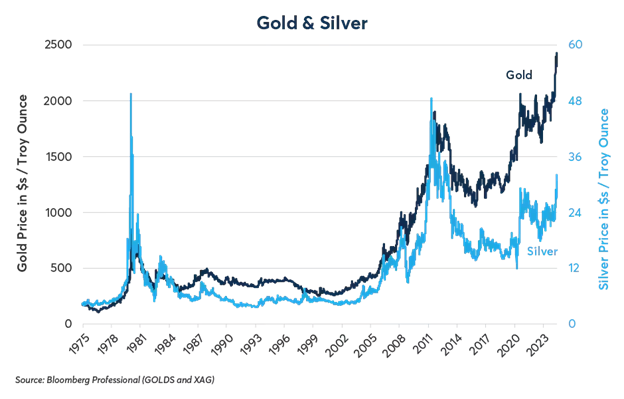 Bloomberg Professional. (2023). Gold & Silver [Graph]. Retrieved from Bloomberg Professional (GOLDS and XAG)
Introduction
Who doesn’t love gold? Gold is a valuable material renowned for its shine and luster, and was one of the first metals recorded to be used by humans. Gold has been used to make religious artifacts, royal jewelry, a form of currency, and even a gift for a baby in a manger. Gold’s influence on the trajectory of humanity is undeniable, as the relentless pursuit of the metal has spurred rulers to take historic risks and make brash geopolitical moves. When we look at the Spanish conquistadors, the Americans in the 1800s, and even today in Sudan, we see that gold has the power to change history. Even today, it continues to make history, reaching a record-breaking $5000 per oz only a week ago on the 26th of January. This historic event was followed by another on January 30, when gold suffered its largest single day price drop, losing 10% of its value! This sudden, unprecedented shift prompts speculation regarding the underlying causes of the crash. Today, I am dissecting potential causes of this historic event and what we can learn from it moving forward.
Gold in our golden age
Today, in our day and age, gold has three practical uses that are used in different sectors of the economy. The tech sector uses gold for its valuable property of being non-corrosive and conductive, making it perfect for circuitry, as it can last much longer than copper or any other material. In the luxury market, gold is king, even over diamonds. Unlike diamonds, gold cannot be made in a lab in any practical sense (Glenn Seaborg was able to create gold ions in a 1980 experiment; he estimated it would cost 1 QUADRILLION dollars to make 1 oz of gold!), and because of this rarity, it naturally holds its value over time. Diamond jewelry loses value quickly because the initial purchase price includes high retail markups driven by firm-level marketing, which is rarely recovered in the resale market. The last sector is what we are actually interested in, and that is the financial sector. As I previously mentioned, gold in its past has been used as a form of coinage, and today it’s not too different. Gold is a real asset that has investment value outside the value of the actual material. It is extremely liquid with global markets available 24 hours a day, every single day. It has a natural scarcity that helps gold keep its value over time, unlike fiat(currency not backed by a physical commodity like gold or silver), which can be much more volatile. Gold’s independence from market and government fluctuations makes it a highly attractive ‘safe’ investment, evidenced by the fact that nearly 40% of the world’s gold is held in private or central bank reserves valued at over 13 trillion dollars.
The rise before the fall
So the million-dollar question is what led to golds meteoric rise this past year and what led to its fall. Simply put, politics. Now, this is not the only reason, but it is one of the main catalysts that helped gold perform so well. From April 2nd of 2025 to January 26th of 2026, gold saw a 75% increase in price in only 10 months. Notably, April 2nd was “Liberation Day” in the United States, a day on which President Trump introduced reciprocal tariffs on countries in a trade deficit with the US. Now, any reasonable economist can understand why there was a trade deficit, as the US is the biggest importer of goods in the world. Furthermore, any economist can see just how impactful and detrimental these tariffs can be on the global supply chain. The event sparked widespread global instability and intensified investor concerns regarding market risk and uncertainty. Thus, investors ran to gold as a safe asset to store their money in these times of uncertainty and drove the price up to record heights. We seen this play out before during the COVID-19 pandemic and the 2008 financial crisis, where investors sought gold during turbulent times. Does this mean geopolitical stability has finally been reached, causing gold to drop? Not quite. The 10% price plunge on January 30th, erasing $7 trillion in value, was actually a direct response to the actions of Donald Trump. On the 30th, Trump announced his nomination for the chairman position of the US Federal Reserve, Kevin Warsh. Kevin Warsh is known as an inflation hawk, leading investors to believe he will prioritize high interest rates to stabilize the economy and strengthen the dollar. Instability and a devaluation in currency are the two main reasons investors would look to invest their funds in gold. This news sparked a massive liquidation of safe-haven positions, as investors shifted toward high risk assets in anticipation of a stabilizing economic landscape, as markets continue to receive new information on the independence of the central bank. This massive reset confirms that gold’s 2025 rally was built largely on policy uncertainty; now that a more hawkish path has been established, gold is seeking a new floor as investors recalibrate their portfolios for a stronger, more disciplined U.S. dollar.